Vine Family Who Wants to Get Wild for Christmas
Last November, a pair of American economists published a working paper with the National Bureau of Economical Research stating that starting time children earn college grades than kids born into more crowded families. Asking questions almost family size and kid success is unsafe. Bring it upwardly in a crowded room and you'll hear that only children are antisocial or deprived, that kids with lots of siblings don't go enough parental attention, that first children are snobby, that first children are statistically likely to exist more than successful than children at the bottom of the stack, that children from big families take fewer psychological problems later in life…
Get-go asking the same questions about what kind of parents grapevines are and the barrage is just about as bad. Does a high-bearing vine with lots of clusters feed and shelter each of them simply besides as one with fewer clusters? Or are grapes from low-yielding vines naturally higher in quality, similar directly-A-earning simply children? Like the but kid/big family debate, nosotros have statistical data. Like the only kid-big family unit debate, the information aren't e'er the last word.
Grape yield isn't directly related to wine quality. Lower yields often practice mean higher quality, but that'due south non because ane causes the other. Information technology's possible, given a whole lot of other factors, for high-quality grapes to come in big lots or in small ones. But grape yield is indirectly related to wine quality; in other words, our data say that a lot of factors frequently associated with yield affect quality.
Because gimmicky science works on the principle of falsifiability – find 1 exception to the dominion and you lot throw the rule out the window – information technology's easy to throw out "lower yields hateful higher quality." A very well-respected 2004 article demonstrated that wines from heavily-pruned, low-yielding Napa cabernet sauvignon vines were more vegetal, astringent, bitter, and less pleasantly fruity than their higher-yielding counterparts. Other research has shown that lower-vigor, lower-yielding sauvignon blanc vines tin can have less punchy varietal flavour. And combinations of vigorous vines, lots of water, and the wrong kind of trellising can hateful low-ish yields of low-ish quality fruit. And then we've proven that principle fake.
Overcropping is conspicuously bad. Vines have a sugar checkbook. Leaves exposed to good, plant-nourishing sunlight bring sugar in with photosynthesis; grapes are saccharide storage units, like savings accounts for carbohydrates. If a vine has too few carbohydrate generating units for its saccharide storage units, those savings accounts won't make full very fast and grapes may not ripen to a winemaker'southward specifications. But every wine drinker knows that quality isn't just about sugars and alcohol. You can't measure out how well kids plough out only past looking at their loftier school class indicate averages.
Hither'due south where we come to the point about quality beingness related to factors associated with yield rather than yield itself. Vines demand leaves to generate carbohydrate, but leaves also shade fruit. Too much shade means grapes with less color and more veggie flavors compared with fruit that sees more sunlight. So college yields tin can mean lower quality if the leaves the vine needs to ripen all of its fruit provide too much shade and brand washed-out wines that smell like the salad bar. Removing leaves early on in the season tin reduce the number of clusters a vine sets out to produce, but also lets more sunlight hit ripening grapes – lower yields, higher quality.
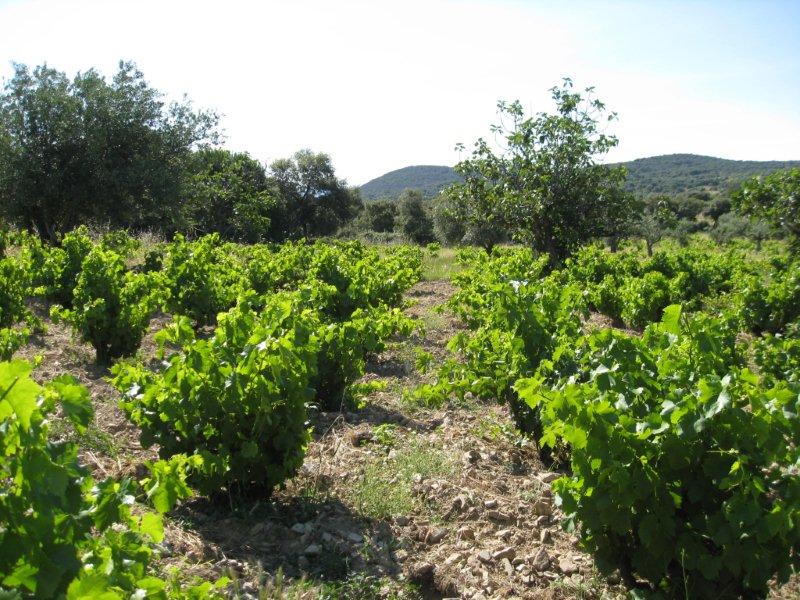 A common style to force lower yields is with mechanical thinning – a tractor with flexible beater bars extending on either side drives downwardly the vineyard row and thwacks the vines to make unripe grapes fall off. The grapes that remain tend to develop into looser, more open up clusters. Those clusters trap less moisture, are less decumbent to rot and mold, and consequently tend to be better-quality than their non-thinned counterparts, at least in terms of diseased-ness.
A less fierce path to lower yields is water stress. With fiddling h2o available – in non-irrigated or barely irrigated vineyards, often on soil with little h2o-holding capacity – vines not simply brand fewer grapes only abound into open, blusterous structures. Blusterous structures hateful more sunlight on ripening grapes, less trapped moisture, and grapes with amend color and flavor and less mold. Low yield isn't causing those changes; depression yield and better quality happen to both be results of the same process.
Altogether, the information tell us that the full grape output of a region, a vineyard, or even a unmarried vine tells usa squat virtually wine quality if we don't know how those yields came to be. Vineyard yield tin be understood at four levels: the vineyard site, the way the vineyard is planted (how far apart the vines are spaced, what kind of vines are planted, what kind of basic trellising system is installed), how the vines are managed, and the conditions. Those billion factors add up to whether a vine is "balanced" at any given yield. I could spend the next year telling you about vine balance and we might all still be ignoramuses when I stopped.
The authors of that 2004 study finding that higher-yielding vines made better cabs surveyed Californian winemakers: 50% of them believed that lower yields meant higher quality grapes and simply twenty% disagreed. Are 50% of Californian winemakers and growers stupid and clueless, or is something more complex going on here? I'one thousand inclined to believe the latter. First, information technology'due south entirely fair to say that yield and quality ofttimes get mitt-in-hand, even if a causal relationship doesn't exist between the 2. 2d, scientific studies are e'er oversimplifications. A properly controlled trial needs to do something to reduce or increase yields from a baseline, and the choice of how to dispense yields has a lot to do with how the wines will turn out. We don't accept scientific studies roofing the entire, incredibly wide gamut of vineyard characteristics and direction practices related to yield, and we have relatively few studies in which "quality" is adamant with a group of humans tasting actual wine rather than unproblematic measurements of sugars and acids or flavor molecules. Winemakers and growers may be incorrect, but I'yard not willing to casually throw out the testimony of a bunch of people who work with wine and vineyards every day in the face up of incomplete scientific show.
How do we define "wine quality?" Even a grouping of humans tasting real wine can't answer that question considering wine quality isn't simply about wine flavour. Lower yielding vines are more expensive, not but considering they produce less just because it normally took expensive manpower hours to make them that way. Nosotros tend to assume that more expensive things are meliorate, and we also tend to value things in low supply. Saying so might be cynical, but winemakers might value low yields in role considering grape growers usually want to debate for college ones. Some part of yield and quality could even be self-fulfilling prophecy: if a grower is getting less out of a vineyard, she'll probably want to believe that higher quality is compensating and may thereby make it and then. And then there's Europe. Many European wine-growing regions place restrictions on yield, at to the lowest degree in part because overcropping to the point of sending ripeness downhill has happened in living memory. Merely they also requite the rest of the so frequently Europe-focused wine world the idea that lower yields are better, full cease.
My Palate Press colleague West. Blake Greyness recently attacked this question from an unusual angle, assuming that if the yield-quality relationship is truthful, so highly desirable California wines from lower-yielding years should be trading for more than money than the same wines from college-yielding years. Gray's methodology was off, but his point was salient: for the consumer, yield isn't a proficient style to cull a vino. I'll hope that screening job applicants for family unit size and nascency club doesn't become common practice, also. Practice lower yields mean higher quality? No. But it's not fair to say that the two are unrelated. And if stacking wine price confronting annual country averages isn't a good manner to answer the question, neither, necessarily, is assuming the whole picture is written in scientific papers.
Source: https://www.palatepress.com/2014/10/kind-parents-grapevines-higher-yields-mean-lower-quality/
0 Response to "Vine Family Who Wants to Get Wild for Christmas"
Post a Comment