ââ⢠Who Is Giotto? When Did He Live and Why Is His Art Important?
Who was Giotto di Bondone? Giotto the artist is regarded every bit among the nearly influential artists in the history of Western art. Giotto di Bondone's art introduced a new historic period in the arts that combined spiritual antiquity with the nascent notion of Renaissance Humanism, predating past a hundred years many of the fascinations and bug of the Italian High Renaissance. Furthermore, many historians feel that the painter Giotto's event on European fine art was unrivaled until Michelangelo assumed his role 200 years afterwards.
Tabular array of Contents
- one A Giotto di Bondone Biography
- 1.i The Childhood of Giotto di Bondone
- 1.two Early Grooming and Career
- 1.3 Mature Menstruation
- 1.four Late Flow
- 2 The Art Style and Legacy of Giotto di Bondone
- 2.one Giotto's About Influential Work
- iii Recommended Reading
- 3.1 Giotto and His Publics (2011) by Julian Gardner
- iii.ii Giotto and His Works in Padua (2016) by John Ruskin
- 3.3 Delphi Complete Works of Giotto (2016) by Peter Russel
- four Frequently Asked Questions
- 4.i Who Was Giotto di Bondone?
- 4.2 What Is Giotto Famous For?
A Giotto di Bondone Biography
Giotto the creative person is most known for probing the potentials of perspectives and aesthetic space, giving his religious stories a new sense of realism. Painter Giotto'south concern with humanism led him to investigate the contradiction between biblical imagery and the ordinary lives of lay worshipers, with the goal of bringing people nearer to God by creating art more than appropriate to their personal experiences.
Giotto's Renaissance characters were therefore imbued with an emotional intensity hitherto unseen in fine fine art, whereas his architectural surround were represented in accord with optical rules of perspective and proportion.
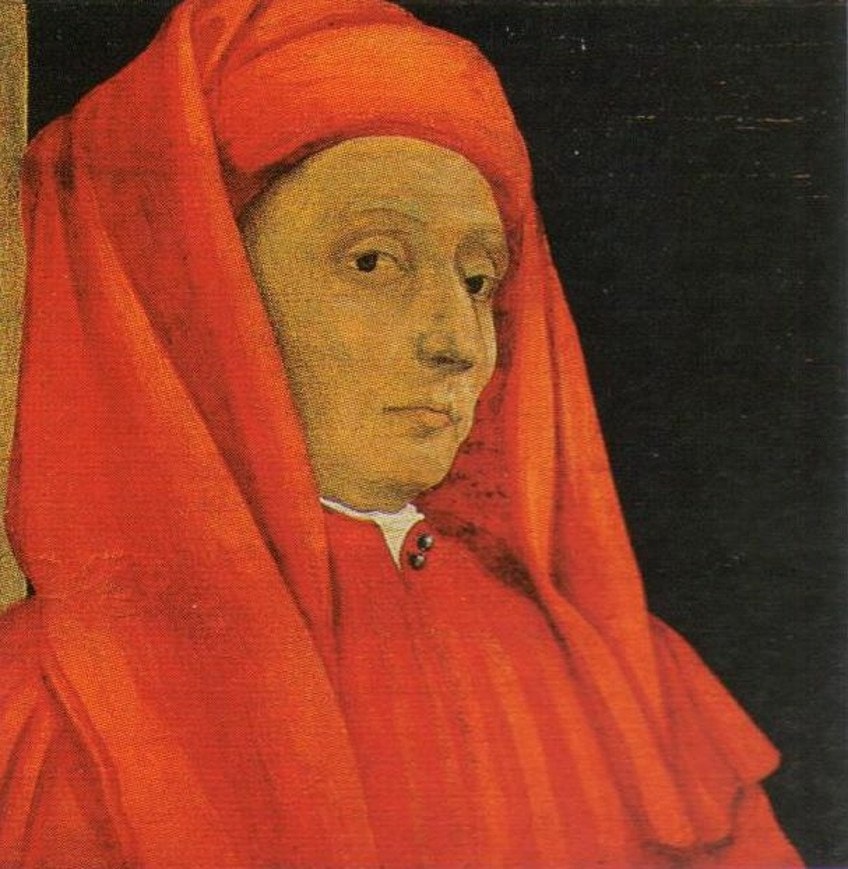 Giotto di Bondone in V Famous Men from the Italian Renaissance (c. the 1490s) by the Florentine School; Florentine School, Public domain, via Wikimedia Commons
Giotto the artist was considered by his peers to be the nigh authoritative virtuoso of art in his day, drawing all of his figures and poses according to reality and his publicly acknowledged bent and quality. He broke with the prevailing Byzantine fashion and pioneered the wonderful style of painting equally we understand it today, inventing the skill of drawing precisely from reality, which had been abandoned for more 200 years.
| Nationality | Italian |
| Date of Nascency | c. 1267 |
| Engagement of Death | 8 Jan 1337 |
| Place of Nativity | Florence, Italy |
The Babyhood of Giotto di Bondone
Giotto is said to have been raised in a farmhouse. Since 1850, a tower firm in adjacent Colle Vespignano has carried an inscription proclaiming the distinction of his birthplace, a claim that has been widely advertised. Recent inquiry, however, has revealed documentary proof suggesting he was actually born in Florence, the child of a blacksmith. Bondone was the proper name of his father. He is considered to have been the kid of a farmer, originating in the Mugello, a hilly region north of Florence that was also the homeland of the Medicis, who rose to prominence in the metropolis.
Some historians believe he was born around 1277, but other sources believe he was born in 1267, which appears more plausible based on the composure of several of his early on pieces.
Early Training and Career
According to Vasari, in his youth, Giotto di Bondone was a shepherd boy, a happy and brilliant youngster who was adored past all who encountered him. Cimabue, the famous Florentine artist, came upon Giotto sketching drawings of his flock on a rock. Cimabue chosen on Giotto and asked if he may bring him on equally an assistant since they were and so lifelike. Vasari tells several accounts of young painter Giotto'south talent.
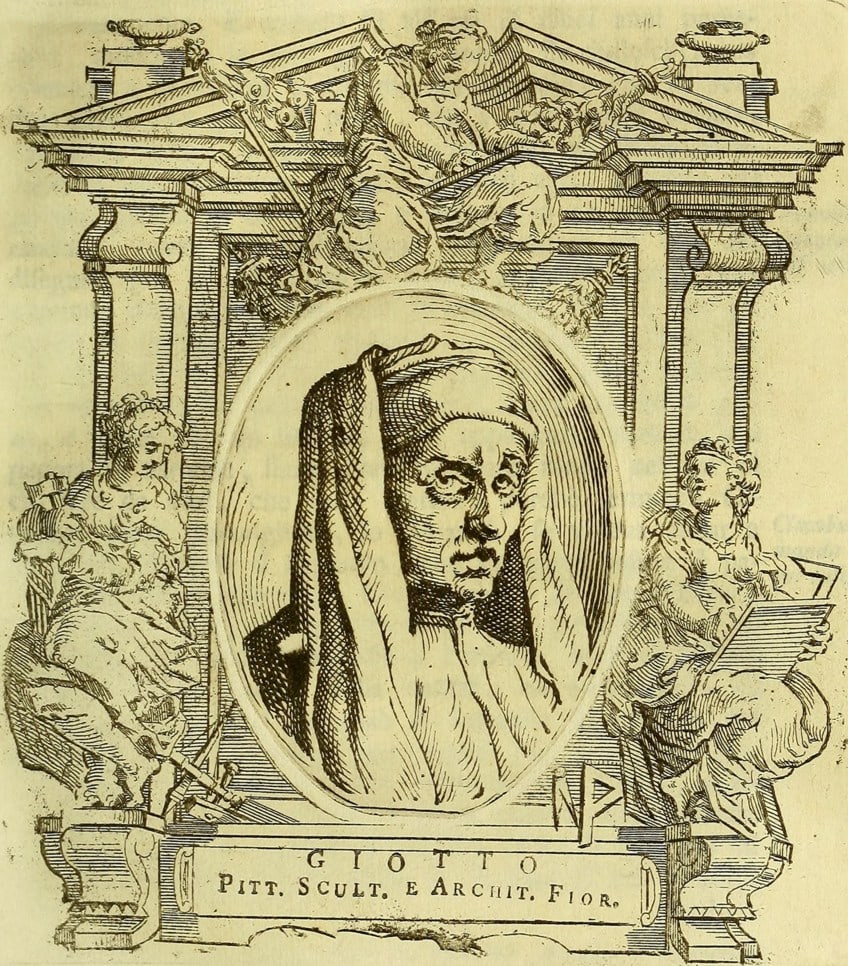 Giotto di Bondone in Giorgio Vasari'southward Lives of the Nigh Excellent Painters, Sculptors, and Architects (Le vite de' più eccellenti pittori, scultori e architettori) (1767); Giorgio Vasari, Public domain, via Wikimedia Eatables
He recalls a twenty-four hour period when Cimabue was not there at the studio and Giotto put a stunningly realistic fly on the brow in a film of Cimabue. When Cimabue arrived, he attempted to motion picture the fly away many times. Many contemporary experts are skeptical of Giotto's teaching and regard Vasari'southward assertion that he was Cimabue's pupil as mythical; they cite older materials that imply Giotto the creative person was not Cimabue's student.
The fly narrative is especially suspicious since it resembles Pliny the Elder'due south narrative nigh Zeuxis depicting grapes so realistically that birds sought to crumb at them.
Whatever the existent origins of their professional connectedness, it is likely that Giotto was taught by Cimabue, most likely starting around the age of x, where he acquired the craft of painting. According to Vasari, when Pope Benedict XI sent out an envoy to Giotto and asked him to produce a picture to illustrate his expertise, the painter Giotto drew a red circumvolve then flawless that it appeared to be washed with a pair of compasses and told the envoy to submit it to the Pope.
The messenger was dissatisfied and left, feeling he had but been fabricated a consummate fool of. Forth with Giotto di Bondone's art, the courier returned to the Pope paintings by other painters. When the messenger described how he had completed the circle without lifting his arm or using compasses, the Pope and his consorts were astounded at how Giotto's talent was far beyond that of his contemporaries.
Although Cimabue was Giotto's instructor, the pupil quickly surpassed his chief, and his talent was acknowledged during his lifetime by contemporaries such as poet Dante Alighieri, who wrote "Oh, the vain pride of human talents! Cimabue expected to retain the field, but now Giotto has the vocalism, and the other's celebrity is lessened."
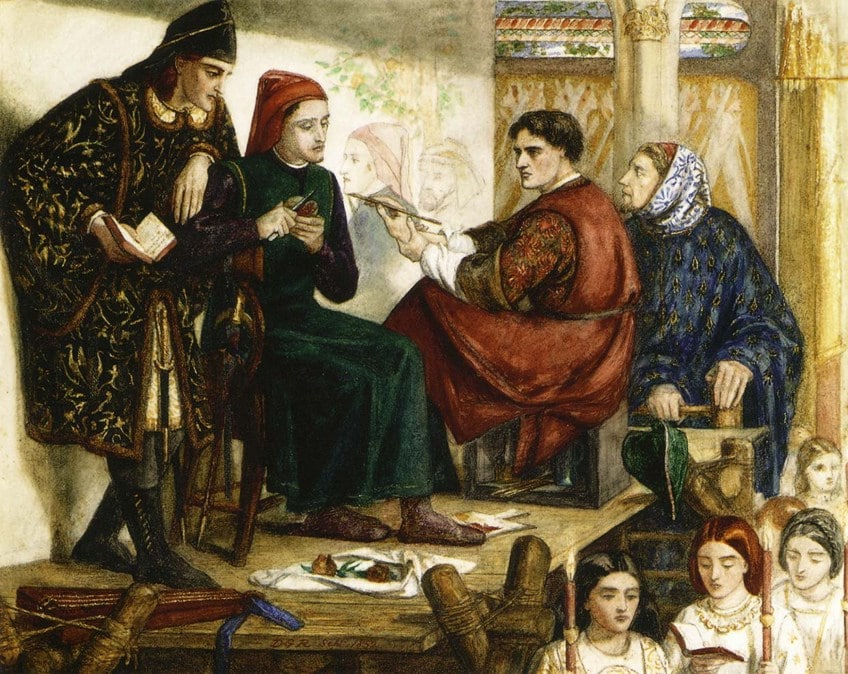 Giotto Painting the Portrait of Dante (1852) past Dante Gabriel Rossetti; Dante Gabriel Rossetti, Public domain, via Wikimedia Commons
Giotto is said to have traveled to Rome with his teacher before following him to Assisi, where he had been appointed to adorn two churches just erected to celebrate St Francis. Although Cimabue traveled to Assisi to pigment numerous big murals for the new Basilica in Assisi, it is conceivable, but not confirmed, that Giotto accompanied him. The provenance of the mural wheel of St. Francis' Life in the College Church has become one of the nearly contentious in fine art history.
Because the Franciscan Friars' documentation pertaining to artistic contracts during this era were destroyed past Napoleon's forces, who stabled animals in the Upper Church of the Basilica, experts have contested Giotto'southward attribution.
In the lack of contradictory evidence, information technology was simple to credit whatever mural in the Upper Church that was not clearly by Cimabue to the amend-known Giotto. It was besides speculated that Giotto may have executed the paintings ascribed to the Master of Isaac. Art experts investigated all of the Assisi paintings in the 1960s and discovered that role of the paint included white atomic number 82, which was also used in Cimabue'south severely deteriorating Crucifixion (c. 1283). This medium is not used in whatsoever of Giotto'southward known works. Nonetheless, Giotto's paintings of St. Francis' Stigmatization (about 1297) have a theme of the saint propping up the crumbling church, which was previously incorporated in the Assisi murals.
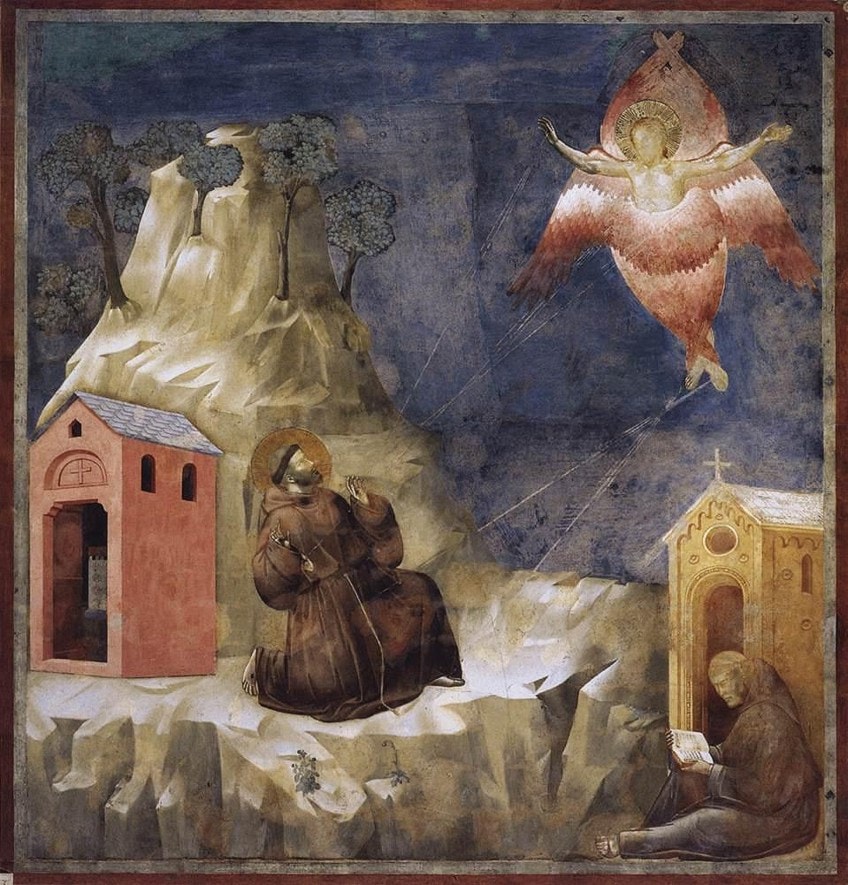 Fable of St Francis: nineteen. Stigmatization of St Francis (between 1297 and 1300) by Giotto di Bondone;Formerly attributed to Giotto, Public domain, via Wikimedia Eatables
The attribution of several panel paintings attributed to the painter Giotto past Vasari, and some others, is equally much debated equally the Assisi paintings. Giotto's initial efforts, according to Vasari, were produced for the Dominican monks at Santa Maria Novella. They feature a mural of The Annunciation and a massive hanging Crucifix that is most 5 meters tall.
It was completed in 1290 and is assumed to be contemporaneous with the Assisi paintings.
Many researchers have questioned Giotto'due south authorship of the Upper Church paintings. Without testify, attributing claims take depended on connoisseurship, a typically untrustworthy "scientific method," simply in 2002, technical investigations and analyses of the studio painting techniques at Assisi and Padua produced credible proof that Giotto the creative person did non produce the St. Francis Cycle.
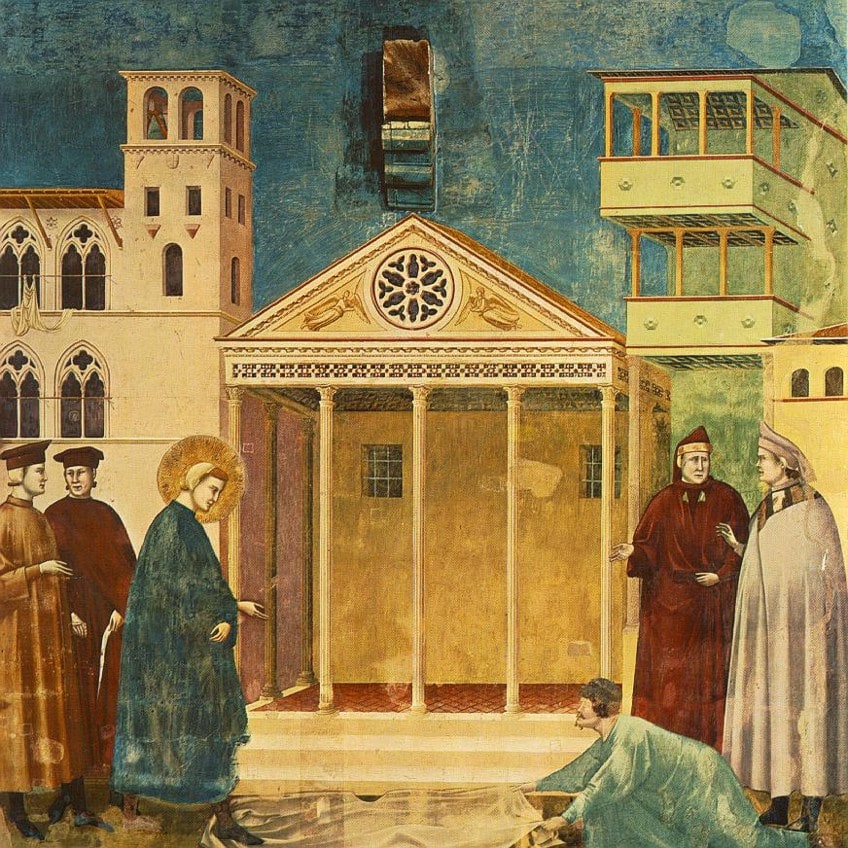 Legend of St Francis: 01. Homage of a Simple Man (1300) from Giotto'southward St. Francis Cycle; Giotto, Public domain, via Wikimedia Commons
Mature Period
Giotto wedded a Florentine lady named Ceuta in 1290, with whom he had several children. Someone reportedly asked Giotto the artist how he could make such beautiful paintings yet generate such hideous offspring, to which he answered that he produced his offspring in the dark. Giotto completed his get-go pregnant piece of work at Assisi from 1290 to 1295, during which he achieved a number of notable graphical improvements.
Giotto di Bondone's fine art was well received, and he was appointed to produce a new bicycle of murals for the cathedral.
Giotto started a period of constant travel throughout the regions of Italia after a reasonably long stay at Assisi, a trend that would ascertain his unabridged career. Giotto established studios in a variety of locales where his technique was replicated and where several of his helpers went on to launch their own careers. Giotto journeyed to Rimini, Florence, and nigh likely Rome around the plow of the century.
He so spent several years in Padua concentrating on the Loonshit Chapel, i of his about significant and well-known masterpieces. Giotto may take encountered the poet Dante, who was exiled in Padua from Florence, during his time there.
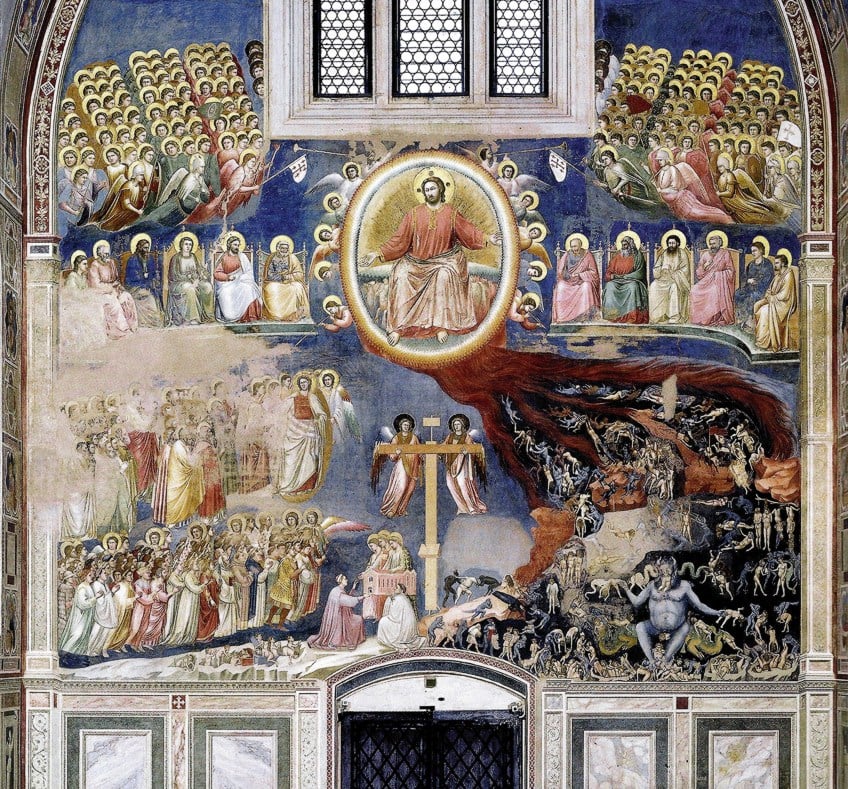 The Terminal Judgment (1306) by Giotto di Bondone at the Loonshit Chapel (Cappella Scrovegni), in Padua; Giotto, Public domain, via Wikimedia Commons
Giotto appears to have traveled from Florence and Rome many times between 1305 and 1315. He embarked on assignments for some of the most prominent churches. The seat of the pope in the early 1300s was not in Rome, only rather it was located in Avignon, France. The cardinals of Rome were battling for the restoration of the pope in their metropolis and commissioned Giotto to create works such as a mosaic for the façade of the ancient St. Peter's Basilica (of which only pieces be), Rome'south most important papal basilica. Cardinal Stefaneschi expressed optimism that the Pope will return and begin to elevate the spiritual significance of his Roman seat.
Every bit part of his political strategy, Stefaneschi is supposed to have commissioned Giotto, who was past this fourth dimension a well-known professional person painter.
During this time, Giotto too got meaning contracts for the Florence church building of Santa Croce. Meanwhile, circa 1313, he was working on a chapel devoted to the Peruzzi's, a wealthy and powerful family unit of bankers, for whom he fabricated two murals portraying John the Baptist and John the Evangelist. The individual of the Peruzzi household who made the asking was named Giovanni and the paintings would seem to exist meant to make a relationship between the household, the town of Florence, and the guardian saints that they adored.
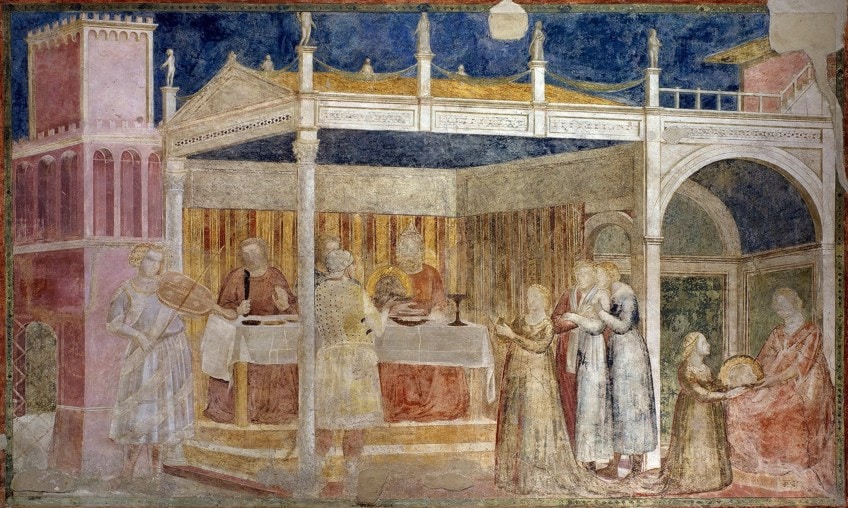 Life of St. John the Baptist: 03. Feast of Herod (1315-1325) by Giotto di Bondone, Peruzzi Chapel, Santa Croce, Florence; Giotto, Public domain, via Wikimedia Commons
The Peruzzi Chapel was highly regarded by Renaissance artists. Indeed, Michelangelo is believed to have studied the paintings in the aboriginal structures that highlighted Giotto'south mastery in chiaroscuro and his bent to effectively limited perspective.
It is also known that Giotto's compositions impacted Masaccio'due south product on Cappella Brancacci afterward on.
According to surviving financial documents, Giotto also produced the renowned altarpiece the Ognissanti Madonna, which is currently held at the Uffizi, between 1314 and 1327. Though Giotto resided in Florence for a time, information technology is believed that he traveled to Assisi sometime around 1316 and 1320 to concentrate on the lower church'due south decoration. When Giotto returned to Rome in around 1320 or 1330, he finished the Stefaneschi Triptych for Central Jacopo.
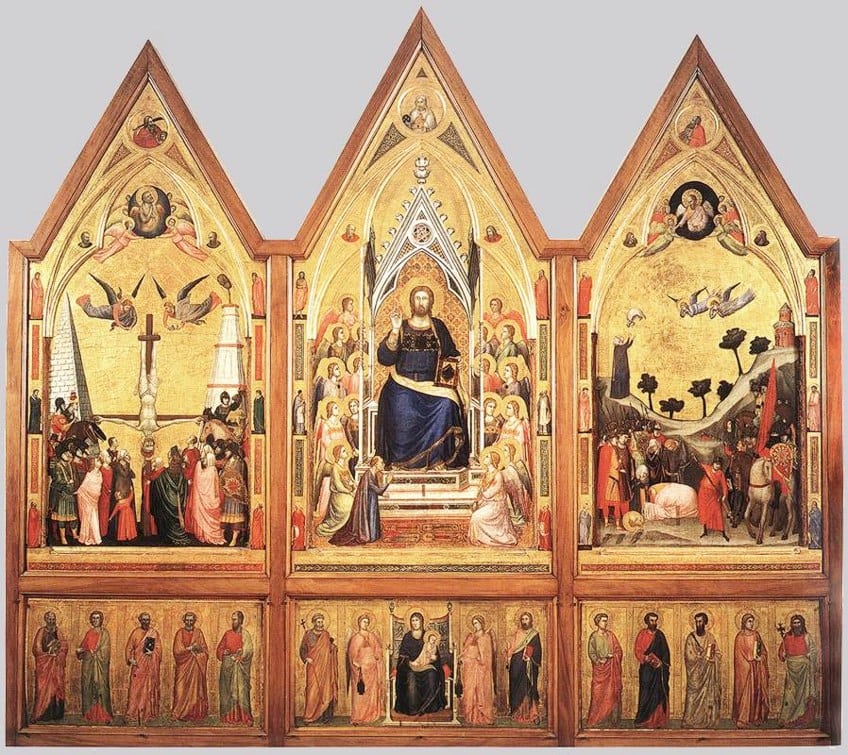 Stefaneschi Triptych (front) (c. 1330) by Giotto di Bondone;Giotto, Public domain, via Wikimedia Eatables
Late Period
Robert of Anjou, King of Naples, called Giotto to his court in 1328. The Bardi household, for whom he had lately produced a series of murals for the household chapel in the church of St. Croce, may have suggested him to Robert of Anjou. Meanwhile, in Naples, Giotto became a court artist, giving up the more than unsafe nomadic lifestyle that had divers his piece of work thus far.
He was paid a wage and a stipend for supplies and services, and in 1330, Robert of Anjou referred to him every bit "familiaris," which meant that he had joined the royal household.
Regrettably, very few of his artworks from this time period have survived. A portion of a fresco depicting Christ's Lamentation in the church of Santa Chiara shows his stamp, and so does the ensemble of Illustrious Men that grace the windows of Castel Nuovo's Santa Barbara Chapel, merely academics commonly assign both works to Giotto's students.
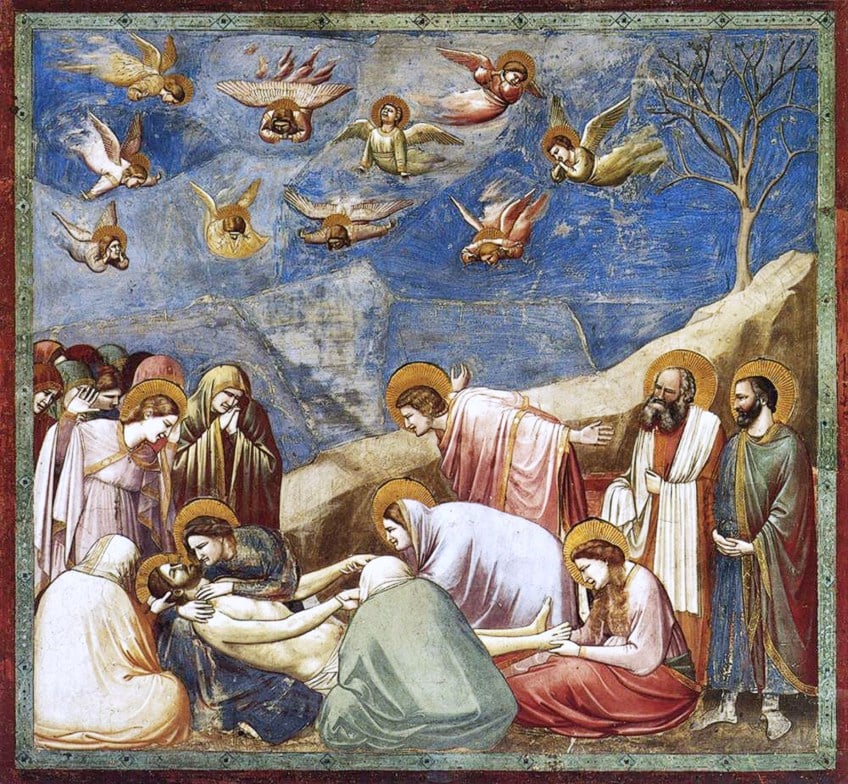 No. 36 Scenes from the Life of Christ: twenty. Lamentation (The Mourning of Christ) (between 1304 and 1306) past Giotto di Bondone;Giotto, Public domain, via Wikimedia Commons
Shortly afterward his recent stay in Naples, Giotto spent a brief catamenia in the city of Bologna, where he completed a Polyptych for the church building of Santa Maria Degli Angeli and, it is thought, a long-lost ornament for Cardinal Legate's Chapel in the castle. Giotto returned to Florence again in 1334. Giotto had become acquainted with Sacchetti and Boccaccio in his later years, and he had also been portrayed in their stories. Sacchetti related an instance in which a layman requested Giotto to create his coat of arms on a shield; Giotto rather portrayed the shield "armed to the teeth," replete with a sword, spear, knife, and arrange of armor.
He was charged after advising someone to "get into culture for a while earlier you speak nigh weaponry like yous're the Duke of Bavaria." Giotto filed a counterclaim and was granted two florins.
He directed the creation of fine art for the erection of Florence'due south cathedral, and his own addition was a bell tower plan (although only the lower part of the tower was eventually constructed to his designs). The new church, which began construction at the end of the 13th century, would not exist finished for another 200 years. Following his passing on the eighth of January, 1337, Giotto was apparently laid in the Santa Reparata at the expense of the city as a reflection of the reverence with which he was held. Giotto was cached in the Cathedral of Florence, on the left side of the entrance, and his burying is marked by a white marble plaque, according to Vasari. According to various stories, he was cached at the Church of Santa Reparata.
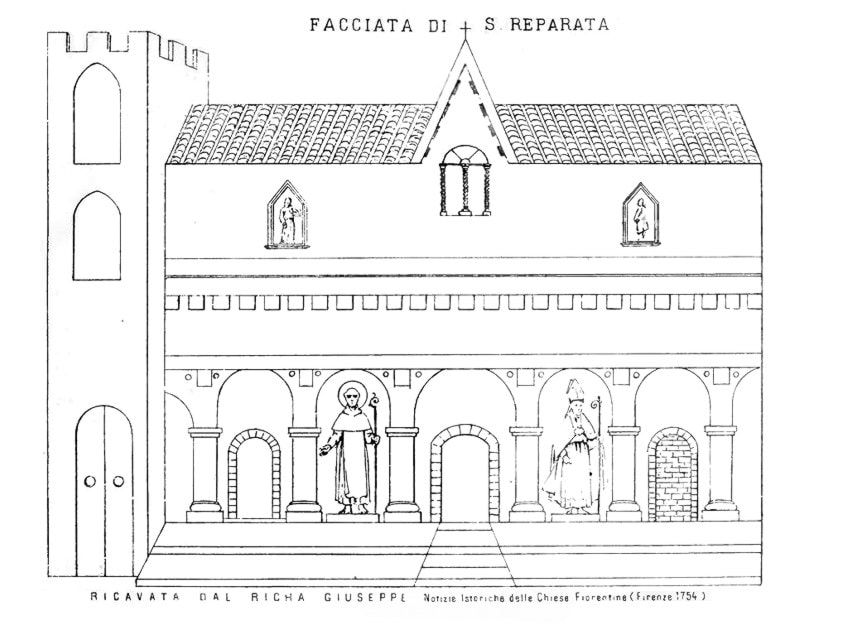 A cartoon of the f acade of the Santa Reparata in Florence;Giaccai, CC BY-SA 4.0, via Wikimedia Commons
The somewhat contradictory traditions are resolved past the knowledge that the remains of Santa Reparata lay precisely below the Cathedral, and the church was nevertheless used in the early on 14th century when the cathedral was being built.
During a 1970s earthworks, bones were uncovered beneath the pavement of Santa Reparata, near the position mentioned by Vasari merely unidentified on either level.
In 2000, anthropologist Francesco Mallegni and a grouping of specialists conducted a forensic analysis of the bones, which revealed some proof which seemed to verify that they were that of an artist – particularly the variety of substances, such as arsenic and lead, both typically found in paint, which the bones had soaked upward. The basic belonged to an extremely short individual, but over iv anxiety in height, who may have had congenital dwarfism.
The Art Style and Legacy of Giotto di Bondone
Giotto had a huge impact on the germination of the Italian Renaissance and, as a consequence, on almost of the evolution of European art. Giotto'south expansions of visual infinite and a want for an unparalleled caste of authenticity would influence the early masterminds of the Renaissance in Florence, and he was recognized as a primary in his own time by poets and intellectuals such as Dante and Boccaccio.
His bear upon may be observed especially in the sculptural revolution started past personalities such equally Donatello and Lorenzo Ghiberti in the first ten years of the 1400s, while his artistic legacy can besides be seen in the works of the young Masaccio ahead of 1420.
Giotto's influence stems mostly from his early forays into Renaissance Humanism, a body of philosophy that would be disquisitional to the growth of Renaissance art. Humanism entailed going to antiquity for noesis and visual skills. This may be observed in Giotto'south work via his focus on conveying human emotions, his depiction of the man figure, and his ability to bridge the gap between biblical figures and human viewers. Giotto'south business in design, proportion, perspective, and fifty-fifty applied science exemplifies his Humanism.
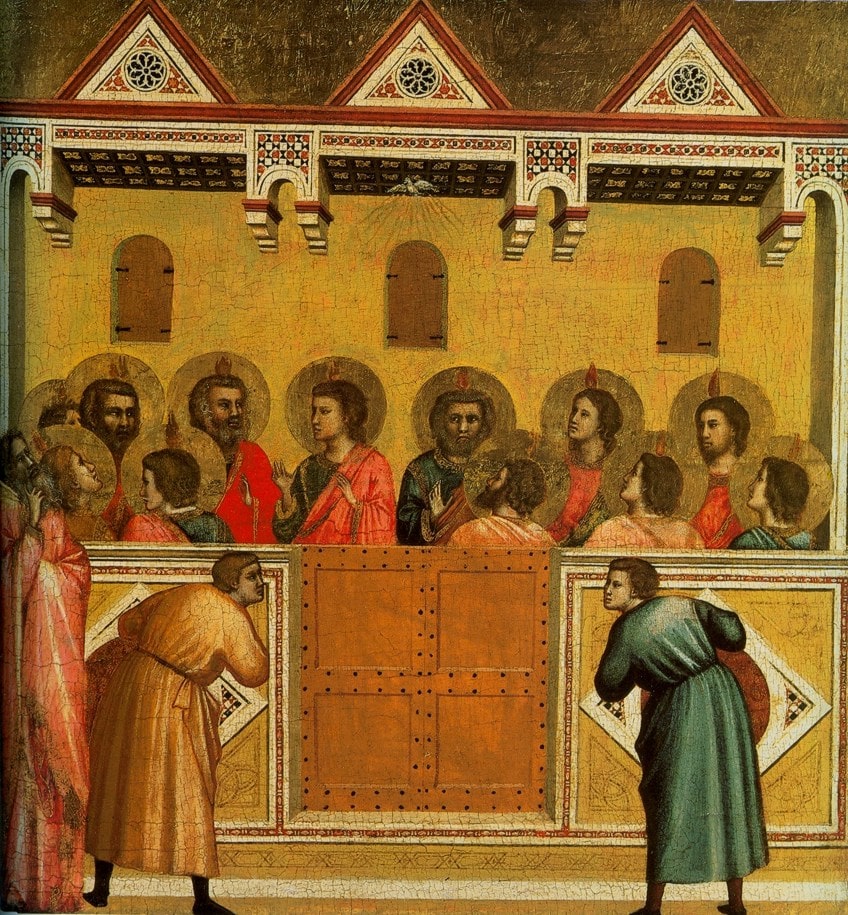 Pentecost (between c. 1310 and c. 1318) by Giotto di Bondone; Giotto and workshop, Public domain, via Wikimedia Eatables
These were besides important parts of subsequent advances in Renaissance humanist thinking and art when humans became vital to creative endeavor and the realistic representation of people and feeling became paramount. Information technology is worth noting that there was a big gap between Giotto's early on revolutionary work about 1300 and the fine art revolution that occurred roughly a century after. This is most likely due to the epidemic and economic low that occurred between Giotto'southward demise and the kickoff of the 15th century.
The plague pandemic of 1348 killed a large number of the residents of Florence, also equally places such as Siena, which had a thriving creative motion and style of its own up to this moment, only from which it never rebounded. Giotto's achievements could not be completely appreciated and expanded upon until the comparative stability and affluence of Florence in the early 1400s.
Later painters acknowledged Giotto'south impact, and his work rekindled attention amid modernists operating in the early half of the twentieth century, including individuals such as Roger Fry and Henry Moore. Giotto is recognized equally being amidst the get-go prominent artists from Italy, instilled in medieval art techniques a new feeling of humanism and expressiveness.
Modernistic painters began to see "flat" Christian artworks as soulless and totally devoid of emotion as a consequence of his influence. Through his care and attending, Giotto's "new realism" accentuated its humanity.
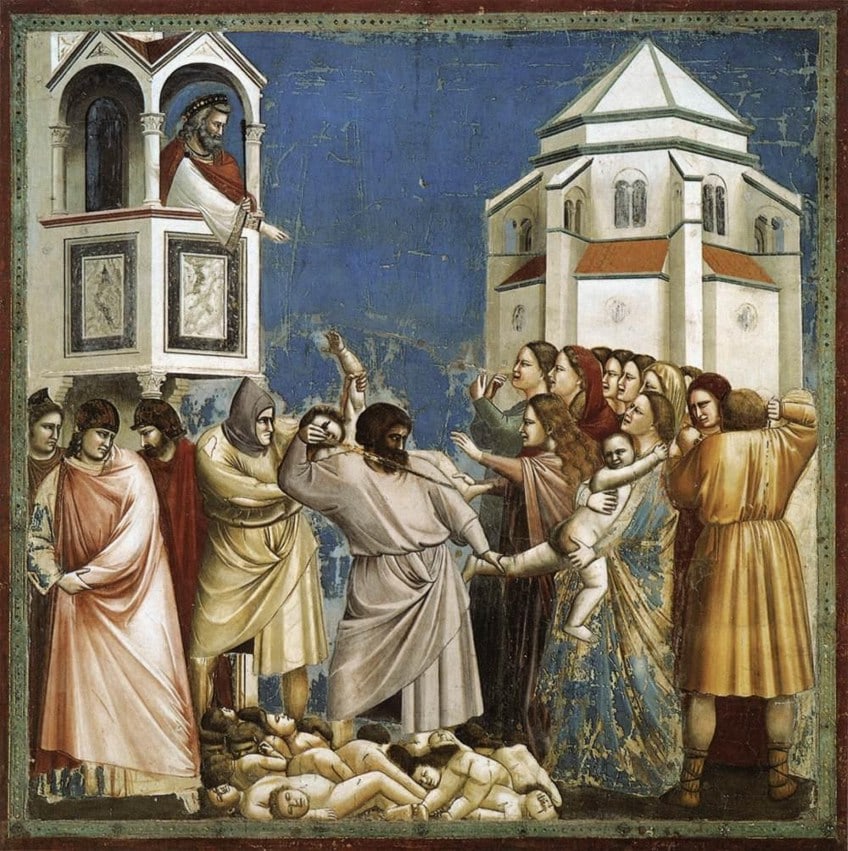 No. 21 Scenes from the Life of Christ: 5. Massacre of the Innocents (betwixt 1304 and 1306) past Giotto di Bondone; Giotto, Public domain, via Wikimedia Commons
His three-dimensional figures were formed with gestures and movements, besides as precise clothes and piece of furniture items. Notwithstanding their commitment to Christ, his humanistic pictures are central to his narrative. Giotto di Bondone was regarded every bit a highly renowned artist during his lifetime. This was partly due to the great Italian poet Dante, who labeled him the virtually notable Italian artist, raising him to a higher place even Cimabue (originally Giotto'south master), who had previously been recognized as the almost outstanding genius of 14th-century painting in Italy.
Giotto was also a well-known architect.
He worked equally a master builder on the Opera del Duomo in Florence, erecting the first phase of the Gothic (intended as much for aesthetic as utility) Bell Tower, which was called after him – Giotto's Bell Tower. The tower is ordinarily regarded every bit Italia's about magnificent campanile. Giotto di Bondone's art style was influenced by Arnolfo di Cambio's strong and classicizing sculpture.
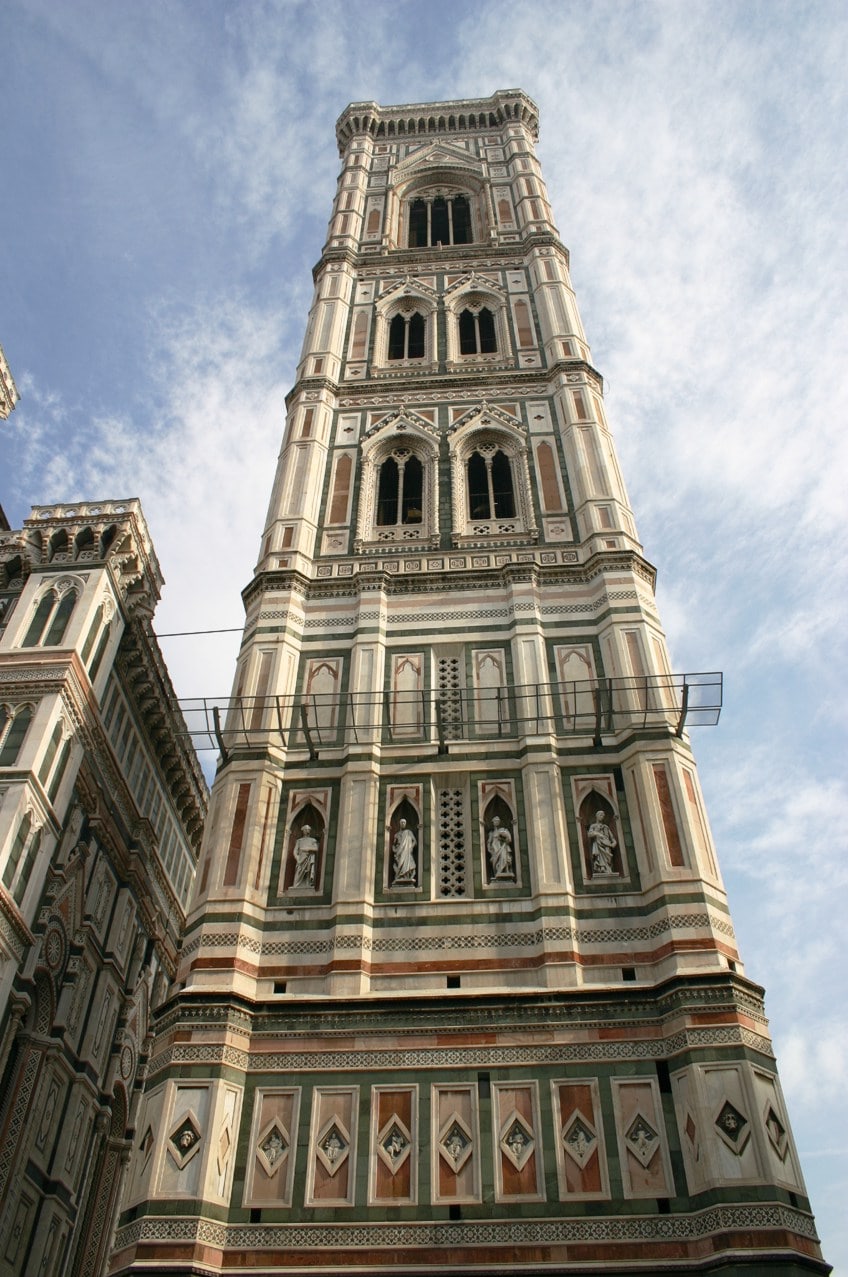 Giotto's bong belfry, situated next to the Santa Maria del Fiore church in Florence, Italy;Giovanni Dall'Orto, Attribution, via Wikimedia Commons
Giotto'due south figures, unlike those of Cimabue and Duccio, are neither stylized nor elongated, and they do not adhere to Byzantine models. They are essentially three-dimensional, with close-observed features and motions, and are dressed in fabrics that hang organically and take shape and weight rather than flowing structured draperies. He also experimented with foreshortening and having figures facing inward, with their backs to the observer, to create the feeling of spaciousness.
The people inhabit compacted surround with realistic aspects, oft employing forced perspective tactics to simulate stage sets.
This resemblance is heightened by Giotto's meticulous placement of the characters in such a mode that the observer seems to take a specific location and even involvement in several of the scenes. This is particularly evident in the placement of the characters in Lamentation (1306) and the Mocking of Christ (1306), in which the limerick invites the observer to become a blasphemer in i and a mourner in the other.
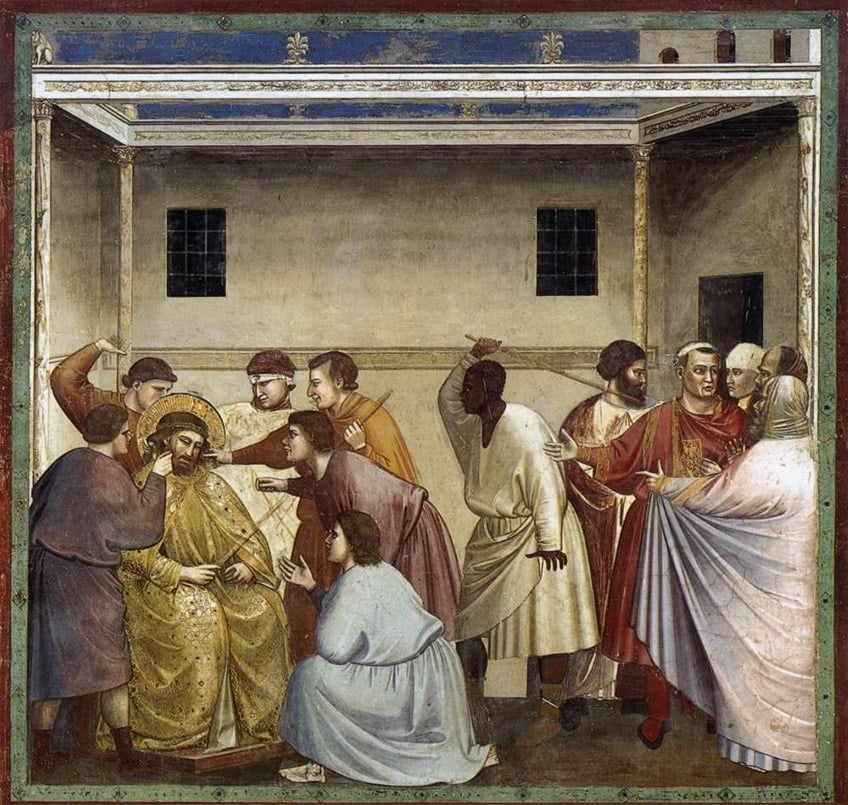 No. 33 Scenes from the Life of Christ: 17. Flagellation (or The Mocking of Christ) (betwixt 1303 and 1306) past Giotto di Bondone; Giotto, Public domain, via Wikimedia Commons
Giotto'southward Renaissance depiction of emotions and facial expressions sets his work autonomously from those of his peers. When the shamed Joachim returns to the hill, the two youthful shepherds exchange sidelong glances. In the Massacre of the Innocents (1305), a soldier takes a wailing infant from its female parent, his head bowed into his shoulders and an expression of humiliation on his face. As they become to Arab republic of egypt, the people around them talk about Mary and Joseph.
"He depicted the Madonna and the Christ and St Joseph, sure, by all means, only primarily Mother, Begetter, and Baby," wrote the English critic John Ruskin of Giotto'south realism.
The Admiration of the Magi (1305), wherein a meteor-like Star of Bethlehem shoots through the sky, is one of the series' near famous stories. Giotto is supposed to accept been influenced by Halley'south comet's 1301 appearance, which resulted in the nickname Giotto being assigned to a 1986 probe to the comet.
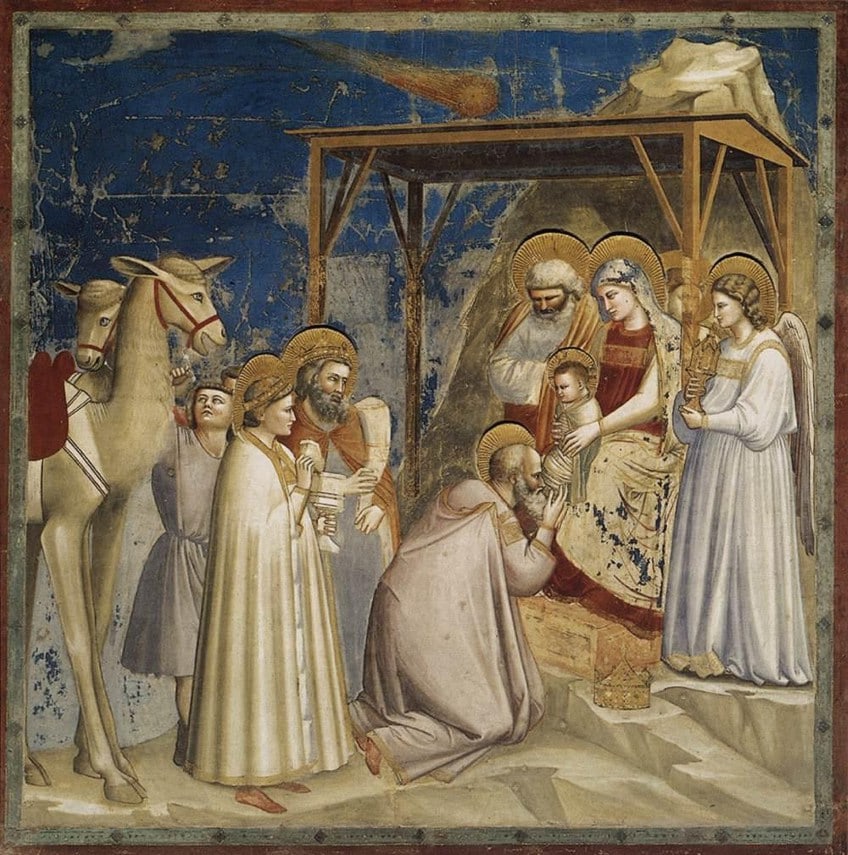 No. 18 Scenes from the Life of Christ: 2. Admiration of the Magi (between 1304 and 1306) by Giotto di Bondone;Giotto, Public domain, via Wikimedia Eatables
Giotto's Virtually Influential Work
Effectually 1305, Giotto completed his most meaning work, the interior frescoes of Padua'due south Scrovegni Chapel, which was designated a UNESCO World Heritage site in 2021, forth with other 14th-century fresco cycles in other structures across the metropolis center. Enrico degli Scrovegni ordered the chapel to be used for family prayer, burying, and as the scene for an almanac mystery play.
The decoration's subject is Salvation, with a focus on the Virgin Mary, equally the church is consecrated to the Proclamation and the Virgin of Clemency.
The Last Judgment (1306) dominates the west wall, as was usual in medieval Italian church décor. The Annunciation is shown by contrasting artworks of the Virgin Mary and the angel Gabriel on either side of the chancel. The paintings, all the same, are more than just depictions of well-known passages, and academics have discovered several sources for Giotto'southward interpretations of religious stories. Here are a few more famous examples of Giotto di Bondone's art:
- Admiration of the Magi (1305)
- Lamentation (1306)
- Kiss of Judas (1306)
- The Last Judgment (1306)
- Pentecost (1306)
- Proclamation (1306)
- Resurrection (1306)
- Madonna and Child (c. 1320-1330)
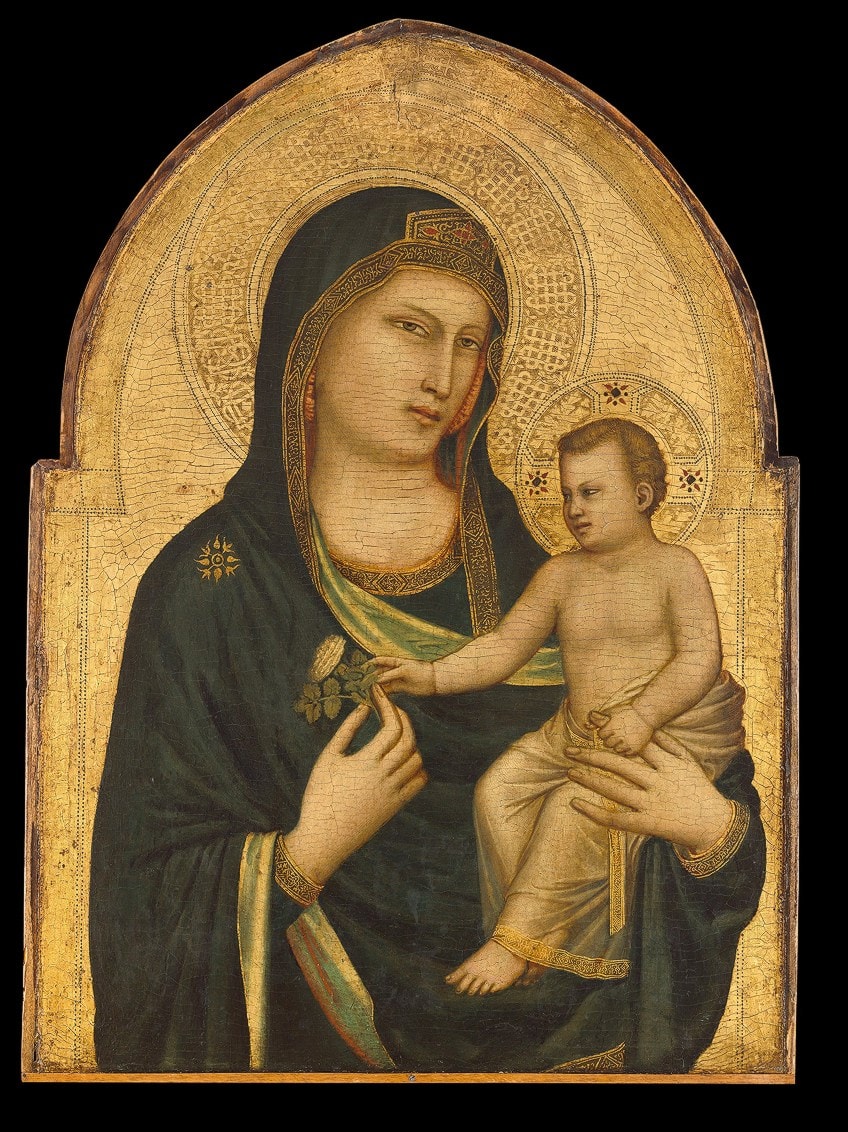 Madonna and Child (c. 1320-1330) by Giotto di Bondone;Giotto, Public domain, via Wikimedia Commons
Recommended Reading
Who was Giotto and why was he famous? We accept tried to embrace all these questions, but perhaps you would like to discover fifty-fifty more about the creative person in a Giotto di Bondone biography and fine art. Therefore, we take compiled a list of recommended books that volition give you even deeper insight into the life of the painter Giotto di Bondone.
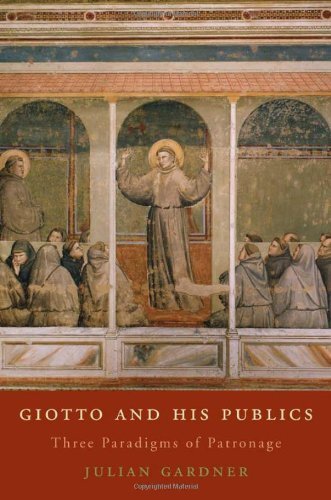
Giotto and His Publics (2011) by Julian Gardner
This in-depth examination of three Giotto works and the patrons who ordered them goes much across the stereotypes of Giotto the artist as the founder of Western painting. It follows the relationships among Franciscan friars and wealthy financiers, shedding lite on the intricate interplay betwixt mercantile riches and poverty imagery. Political conflict and theological schism slashed fourteenth-century Italian republic. Giotto'due south assignments are interpreted within the context of this societal upheaval. They represented his sponsors' requests, the Franciscan Lodge'southward regulations, and the painter'southward restless imaginative creativity.
These paintings were created during a 20-twelvemonth period in which the friars were split internally and the Social club was presented with a major shift in papal policy regarding its distinguishing vow of poverty. The Order had gained considerable money and constructed extravagant churches, repelling many Franciscans and earning the animosity of other Orders in the process. Many aspects in Giotto'south paintings were incorporated to appease clients, reinterpret the persona of Francis, and glorify the ruling faction within the Franciscan fraternity, incorporating links to St. Peter, Florentine economics, and church construction.
View on Amazon
Giotto and His Works in Padua (2016) by John Ruskin
Scholars chose this work equally culturally meaning, and it is at present part of the intellectual foundation of society as we recognize it. This work was copied from the original particular and is equally accurate as possible to the original. As a upshot, you will observe the original copyright citations, library stamps – equally the majority of these publications have been stored in our most significant libraries throughout the earth – and other transcriptions in the work. Scholars feel, and we agree, that this fabric is significant plenty to exist saved, duplicated, and widely distributed to the public. We appreciate your assistance in the preservation try, and we give thanks y'all for your contribution to keeping this information live and relevant.

- A set of reflections on Giotto's Arena Chapel fresco wheel
- A new edition that presents each work in bright color photography
- Ekphrastic writing by John Ruskin allows readers to experience art
View on Amazon
Delphi Consummate Works of Giotto (2016) by Peter Russel
Giotto di Bondone was the prominent Artist of the 14th century, whose groundbreaking paintings would bring on to the discoveries and marvels of the High Renaissance. He is regarded as the founder of European art and the beginning of great Italian painters. Delphi's Masters of Fine art Series introduces the globe'south premier digital e-Art books, enabling consumers to thoroughly examine the works of renowned painters. This collection beautifully exhibits Giotto's consummate works, with succinct introductions, hundreds of loftier-quality photographs, and the typical Delphi supplementary content.
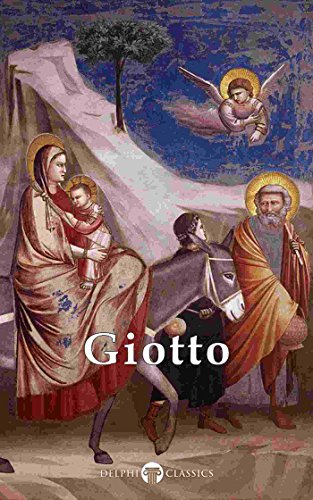
- The world's first digital e-Art book on Giotto's complete works
- With hundreds of Giotto'southward paintings and rare works in stunning color
- Features highlights, bonus biographies, and enlarged "detail" images
View on Amazon
Giotto the artist is recognized as one of the most significant painters in Western art history. Giotto's Renaissance style heralded a new era in the arts by combining spiritual antiquity with the embryonic idea of Renaissance Humanism, predating many of the fascinations and difficulties of the Italian High Renaissance by 100 years. Furthermore, many historians believe that the painter Giotto had an unequaled touch on on European fine art until Michelangelo resumed his role 200 years later.
Frequently Asked Questions
Who Was Giotto di Bondone?
Giotto di Bondone was an artist from Italy. Giotto was perhaps the most supreme creative person in his day, drawing all his models and their poses truthful to nature, and his power and quality were well acknowledged. Giotto was credited with ushering in the magnificent painting and sculpture as we know information technology now, establishing the method of drawing precisely from life, which had been ignored for more two hundred years.
What Is Giotto Famous For?
Giotto de Bondone was a notable 14th-century artist whose pioneering paintings paved the way for the High Renaissance'due south discoveries and miracles. He is often considered the father of painting in Europe and the very first of the bully painters to come from Italy. The assignments of Giotto are best understood from the perspective of this socio-economic upheaval. Giotto's most of import work, the interior paintings of Padua'southward Scrovegni Chapel, was finished about 1305 and was named a UNESCO World Heritage site in 2021.
Source: https://artincontext.org/giotto-di-bondone/
0 Response to "ââ⢠Who Is Giotto? When Did He Live and Why Is His Art Important?"
Post a Comment