A Site That Can Help You Strengthen Skills in Writing a Literature Review in Psychology
Chapter ii: Getting Started in Research
Reviewing the Research Literature
- Define the research literature in psychology and give examples of sources that are role of the research literature and sources that are not.
- Describe and use several methods for finding previous research on a item research idea or question.
Reviewing the enquiry literature means finding, reading, and summarizing the published research relevant to your question. An empirical inquiry report written in American Psychological Association (APA) way always includes a written literature review, but it is important to review the literature early in the enquiry procedure for several reasons.
- It can help you lot plough a research idea into an interesting inquiry question.
- It tin tell yous if a inquiry question has already been answered.
- It can help you lot evaluate the interestingness of a research question.
- It can give you ideas for how to conduct your own study.
- It can tell y'all how your written report fits into the research literature.
What Is the Research Literature?
The in any field is all the published research in that field. The enquiry literature in psychology is enormous—including millions of scholarly articles and books dating to the first of the field—and it continues to grow. Although its boundaries are somewhat fuzzy, the research literature definitely does not include cocky-help and other pop psychology books, dictionary and encyclopedia entries, websites, and similar sources that are intended mainly for the general public. These are considered unreliable because they are non reviewed by other researchers and are ofttimes based on little more than mutual sense or personal experience. Wikipedia contains much valuable data, just the fact that its authors are anonymous and may not take any formal training or expertise in that subject area, and its content continually changes makes it unsuitable as a ground of sound scientific inquiry. For our purposes, it helps to define the research literature as consisting almost entirely of two types of sources: articles in professional journals, and scholarly books in psychology and related fields.
Professional Journals
are periodicals that publish original research articles. At that place are thousands of professional journals that publish research in psychology and related fields. They are ordinarily published monthly or quarterly in individual issues, each of which contains several articles. The problems are organized into volumes, which usually consist of all the problems for a agenda year. Some journals are published in hard copy only, others in both hard copy and electronic form, and however others in electronic class just.
Most articles in professional journals are one of 2 bones types: empirical enquiry reports and review articles. draw one or more than new empirical studies conducted by the authors. They introduce a inquiry question, explicate why it is interesting, review previous research, describe their method and results, and depict their conclusions. summarize previously published enquiry on a topic and usually present new means to organize or explicate the results. When a review commodity is devoted primarily to presenting a new theory, information technology is often referred to as a .
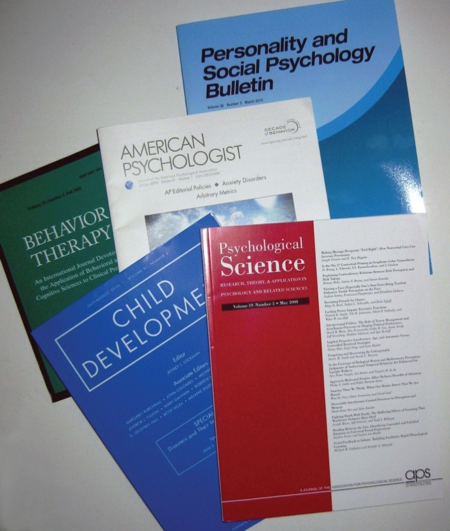
About professional journals in psychology undergo a process ofdouble-bullheaded peer review. Researchers who want to publish their piece of work in the journal submit a manuscript to the editor—who is generally an established researcher as well—who in turn sends it to two or three experts on the topic. Each reviewer reads the manuscript, writes a critical simply constructive review, and sends the review back to the editor along with his or her recommendations. The editor then decides whether to accept the article for publication, ask the authors to make changes and resubmit it for further consideration, or reject it outright. In whatsoever case, the editor forward the reviewers' written comments to the researchers then that they tin can revise their manuscript accordingly. This entire process is double-blind, as the reviewers do not know the identity of the researcher(s), and vice versa. Double-blind peer review is helpful considering it ensures that the work meets basic standards of the field before it can enter the research literature. However, in lodge to increase transparency and accountability some newer open access journals (e.g., Frontiers in Psychology) apply an open peer review process wherein the identities of the reviewers (which remain concealed during the peer review procedure) are published alongside the journal article.
Scholarly Books
are books written by researchers and practitioners mainly for apply past other researchers and practitioners. A is written past a single writer or a small-scale group of authors and normally gives a coherent presentation of a topic much similar an extended review commodity. accept an editor or a small group of editors who recruit many authors to write separate chapters on different aspects of the same topic. Although edited volumes can also give a coherent presentation of the topic, it is non unusual for each affiliate to have a dissimilar perspective or fifty-fifty for the authors of dissimilar capacity to openly disagree with each other. In general, scholarly books undergo a peer review procedure like to that used by professional journals.
Literature Search Strategies
Using PsycINFO and Other Databases
The primary method used to search the inquiry literature involves using one or more electronic databases. These include Academic Search Premier, JSTOR, and ProQuest for all academic disciplines, ERIC for education, and PubMed for medicine and related fields. The well-nigh of import for our purposes, withal, is PsycINFO, which is produced past the APA. is so comprehensive—covering thousands of professional person journals and scholarly books going back more than 100 years—that for most purposes its content is synonymous with the research literature in psychology. Like nearly such databases, PsycINFO is usually available through your academy library.
PsycINFO consists of individual records for each commodity, volume chapter, or book in the database. Each record includes basic publication information, an abstract or summary of the work (similar the one presented at the start of this chapter), and a listing of other works cited by that piece of work. A computer interface allows entering one or more search terms and returns whatsoever records that comprise those search terms. (These interfaces are provided past different vendors and therefore can await somewhat different depending on the library you use.) Each record too contains lists of keywords that describe the content of the work and also a list of alphabetize terms. The index terms are especially helpful because they are standardized. Enquiry on differences between women and men, for instance, is ever indexed under "Human Sexual activity Differences." Research on notetaking is ever indexed under the term "Learning Strategies." If you do not know the appropriate index terms, PsycINFO includes a thesaurus that can aid you observe them.
Given that in that location are nearly four million records in PsycINFO, you may have to endeavour a variety of search terms in unlike combinations and at different levels of specificity earlier you find what you are looking for. Imagine, for instance, that you are interested in the question of whether women and men differ in terms of their ability to recall experiences from when they were very young. If y'all were to enter "memory for early experiences" every bit your search term, PsycINFO would render only six records, near of which are non particularly relevant to your question. Notwithstanding, if you were to enter the search term "memory," it would return 149,777 records—far as well many to look through individually. This is where the thesaurus helps. Entering "memory" into the thesaurus provides several more than specific index terms—one of which is "early memories." While searching for "early memories" among the alphabetize terms returns ane,446 records—still too many likewise look through individually—combining information technology with "man sexual activity differences" as a second search term returns 37 articles, many of which are highly relevant to the topic.
Depending on the vendor that provides the interface to PsycINFO, you lot may be able to salvage, print, or e-mail the relevant PsycINFO records. The records might fifty-fifty comprise links to full-text copies of the works themselves. (PsycARTICLES is a database that provides full-text access to articles in all journals published by the APA.) If non, and you lot want a copy of the work, you will accept to find out if your library carries the periodical or has the book and the hard copy on the library shelves. Be certain to inquire a librarian if yous demand help.
Using Other Search Techniques
In addition to entering search terms into PsycINFO and other databases, there are several other techniques yous can utilize to search the inquiry literature. First, if you have i good article or volume chapter on your topic—a recent review article is best—you can look through the reference list of that article for other relevant articles, books, and book capacity. In fact, you should practice this with any relevant article or book chapter you lot notice. You tin also starting time with a classic commodity or book chapter on your topic, find its record in PsycINFO (past entering the author'southward name or commodity'due south title as a search term), and link from in that location to a list of other works in PsycINFO that cite that classic article. This works because other researchers working on your topic are likely to be enlightened of the classic article and cite it in their own piece of work. Yous can besides exercise a general Internet search using search terms related to your topic or the name of a researcher who conducts research on your topic. This might pb you directly to works that are function of the research literature (e.g., articles in open-admission journals or posted on researchers' own websites). The search engine Google Scholar is specially useful for this purpose. A full general Cyberspace search might also lead you to websites that are not office of the enquiry literature merely might provide references to works that are. Finally, you lot tin can talk to people (e.g., your instructor or other faculty members in psychology) who know something about your topic and can suggest relevant manufactures and book chapters.
What to Search For
When you do a literature review, you need to be selective. Not every article, volume chapter, and book that relates to your enquiry idea or question will be worth obtaining, reading, and integrating into your review. Instead, you want to focus on sources that help you do iv basic things: (a) refine your enquiry question, (b) identify appropriate research methods, (c) place your research in the context of previous research, and (d) write an effective research study. Several basic principles can help you lot find the well-nigh useful sources.
First, it is best to focus on recent enquiry, keeping in mind that what counts as recent depends on the topic. For newer topics that are actively existence studied, "recent" might hateful published in the past year or two. For older topics that are receiving less attention right now, "recent" might mean inside the by ten years. You volition become a feel for what counts as recent for your topic when yous start your literature search. A good general rule, still, is to beginning with sources published in the past five years. The main exception to this dominion would be classic articles that turn up in the reference listing of nearly every other source. If other researchers think that this work is important, even though it is old, then past all means yous should include it in your review.
Second, you should look for review articles on your topic because they will provide a useful overview of it—often discussing important definitions, results, theories, trends, and controversies—giving you a good sense of where your own research fits into the literature. You should also look for empirical inquiry reports addressing your question or similar questions, which tin requite y'all ideas about how to operationally define your variables and collect your data. Equally a general rule, information technology is good to apply methods that others accept already used successfully unless yous have good reasons not to. Finally, y'all should expect for sources that provide information that can aid you contend for the interestingness of your inquiry question. For a study on the furnishings of cell phone use on driving ability, for example, you might await for information nearly how widespread jail cell telephone utilise is, how frequent and costly motor vehicle crashes are, and then on.
How many sources are plenty for your literature review? This is a hard question because information technology depends on how extensively your topic has been studied and also on your ain goals. One study found that across a variety of professional person journals in psychology, the average number of sources cited per commodity was nigh l (Adair & Vohra, 2003)[1]. This gives a crude thought of what professional researchers consider to be acceptable. As a student, you might be assigned a much lower minimum number of references to use, merely the principles for selecting the most useful ones remain the aforementioned.
- The research literature in psychology is all the published research in psychology, consisting primarily of articles in professional journals and scholarly books.
- Early in the research process, information technology is important to bear a review of the research literature on your topic to refine your research question, identify appropriate enquiry methods, identify your question in the context of other research, and set to write an effective inquiry report.
- There are several strategies for finding previous research on your topic. Among the best is using PsycINFO, a calculator database that catalogs millions of manufactures, books, and book chapters in psychology and related fields.
- Practice: Use the techniques discussed in this department to find 10 journal articles and book chapters on one of the following research ideas: memory for smells, aggressive driving, the causes of egotistic personality disorder, the functions of the intraparietal sulcus, or prejudice against the physically handicapped.
- Spotter the following video prune produced by UBCiSchool about how to read an academic paper (without losing your mind):
Video Attributions
- "Sample PsycINFO Search on EBSCOhost" past APA Publishing Training. Standard YouTube Licence.
- "Using Google Scholar (Prune)" by clipinfolit. CC Past (Attribution)
- "How to Read an Academic Paper" past UBCiSchool. CC BY (Attribution)
Source: https://opentextbc.ca/researchmethods/chapter/reviewing-the-research-literature/
0 Response to "A Site That Can Help You Strengthen Skills in Writing a Literature Review in Psychology"
Post a Comment